Pest Control During The Philadelphia Garbage Strike
On Tuesday, July 1, 2025, Philadelphia’s trash collectors went on strike. It is everything a pest could ever ask for. Uncollected garbage means free food, and lots of it, piling up across the city. Pests don’t see garbage the way people do; they see a city-sized buffet. Pests will come out of wherever they are hiding to take part in their unexpected bounty. Most pests breed rapidly, but the epic trash buildup could cause populations to grow exponentially. And with those increased populations come increases in pest-related ailments, ranging from diseases to asthma triggers to food contamination. The longer the strike lasts the worse the pest problems will get. This extreme situation will require an aggressive and proactive pest control response if you want to minimize pest-related risks to your Philadelphia home or business.
Rodent Risks Run Rampant
The pest population explosion will be most dire for businesses that produce substantial food waste. Restaurants and grocery stores need to be especially concerned, as there will be exponentially higher pest pressure on their exteriors. It is imperative for food waste to be disposed of carefully in sealed containers whenever possible. Rats can and will chew through thin plastic bags, so bagging will not be enough.
Though preventing pests will be substantially more difficult during and in the aftermath of the strike, customers will still react negatively to signs of pest infestation. Seeing a rat or cockroach in your place of business will still cause significant negative publicity, and, fair or unfair, it’s unlikely that customers will grade you on a curve.
But a substantial increase in pests will do more than reputational damage to businesses. More pests mean more risk of pest-related ailments for you, your family, and your pets. With increases in the number of mice, flies, roaches, ants, and rats in Philadelphia, come the associated health risks. Rats are known for spreading diseases like Salmonella, Leptospirosis, and Typhus. These diseases can spread through contact with urine, feces, or saliva, or by getting bitten. This contamination is especially hazardous on urban streets where the mere act of drinking from an afflicted puddle can make your dog dangerously, potentially fatally sick. Increases in cockroach populations mean more allergic and asthmatic reactions. Flies, among the least sanitary of all pests, are known for spreading Dysentery, gastroenteritis, E. Coli, typhoid, and conjunctivitis.
Anticimex SMART: Modern Rodent Control
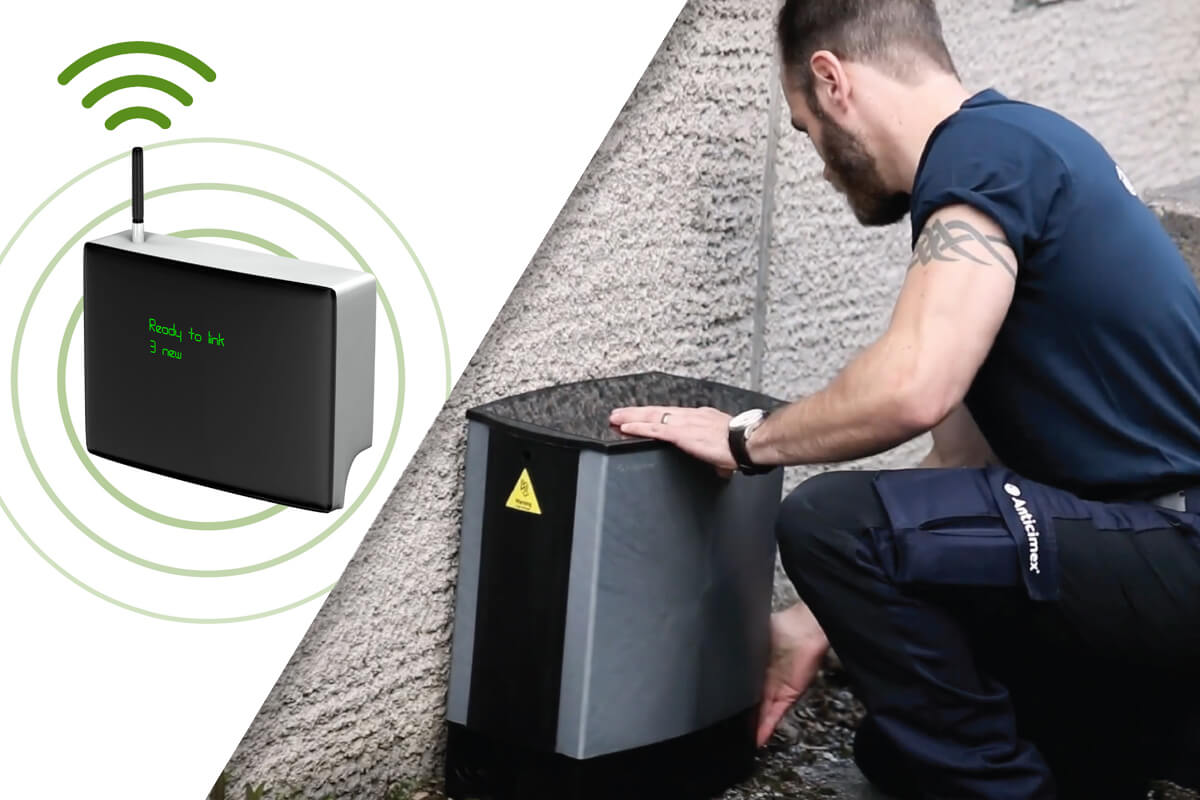
All pests are a threat to home and business sanitation, making it even more important that you keep your space clean and disinfected. The key to staying ahead of this surge in pest activity is quick intervention. Viking Pest Control is the exclusive provider of SMART rodent control in Philadelphia. This advanced pest monitoring system can track rodent activity 24/7, helping to catch infestations early before they can fully begin. If pest populations are allowed to explode, the cost, time, and effort to manage infestations will skyrocket. Waiting until pests have taken root inside your walls, kitchen, or storage areas is a costly mistake. The smartest move is to act now—before pests get the upper hand.
Don't Wait, Call Viking for Professional Mice Control Today!
Viking Pest Control offers expert pest management professionals and proven solutions tailored to this pest control crisis. Whether you’re a homeowner looking to protect your family from rats in Philadelphia or a business owner needing to safeguard your reputation and inventory, our Integrated Pest Management (IPM) approach delivers results that are fast, effective, and environmentally responsible.
We offer discreet, professional service for businesses and comprehensive home protection plans for residences in the Philadelphia area and beyond. With cutting-edge tools, local expertise, and a proactive mindset, we can help you endure this surge and recover quickly.
Don’t wait for the next trash pile to become a breeding ground. Contact Viking Pest Control today for a free estimate and start protecting what matters most.
Delaware's Best Pest Control
Delaware is a beautiful and exciting place to live. Its location makes it an ideal hub of business activity in the Northeastern region of the United States. As the first state, it boasts a rich history and substantial cultural significance. It has miles of shoreline and gorgeous scenery.
The state of Delaware has hot summers and cold winters, with plenty of precipitation no matter the season. However, Delaware's climate along with its diverse natural features that include everything from beaches to mountains to rivers to picturesque countryside make it a prime location for pest activity.
Delaware Pest Problems
Insects and rodents remain active year-round in Delaware. The hot and humid summers lead to big increases in populations. Once colder weather sets in, these pests begin to look for shelter and alternative food sources. Unfortunately for Delaware residents and business owners, this typically means that they attempt to find a way inside your property.
An infestation of pests is more than annoying. Their presence can cause a number of health and safety concerns, along with the risk of property damage. Thankfully, Viking Pest Control is here to help. If you notice any signs of pests in your home or business, contact the best exterminator in Delaware.
Viking Pest Control Services
Viking provides a full range of local pest control services for homes and businesses. Some of our most popular treatments and service plans include:
Home protection plans
Mosquito and tick control
Overwintering pest plans
SMART rodent control
Termite bait systems
Spotted Lanternfly treatments
We use the newest technology to create customized pest control solutions that address your needs. Whether you need help eliminating a current infestation or want to explore options for pest prevention, we can help. Our treatments are safe, sustainable, and adapted to target the pests specific to Delaware so you get excellent results.
Award-Winning Pest Control
Viking Pest Control has gained a reputation for delivering effective and efficient pest control services throughout its 40 years of business, winning multiple awards for sustainable pest control services from popular publications like Forbes Home, The Spruce, and Houzz.
For the second year, Forbes Home magazine honored Viking with three noteworthy achievements, naming it as one of the Top 10 Pest Control Companies in the Country, the Top 5 Mosquito Control Companies, and the Best Termite Control Company in the country. Viking was named the Best Pest Control Company for Sustainability by The Spruce for the third year in a row and was selected Best of Houzz by the Houzz homeowners community.
Viking works hard to deliver effective results for every customer, which shows clearly in its national and local recognition. This impressive feat solidifies Viking as one of the best pest control companies in Delaware.
Get the Best Pest Control in Delaware
At Viking, we take the stress out of keeping your home or business safe from pests. We provide customizable, superior services at affordable prices. Our solutions are designed for your unique situation, to provide a healthy environment free from bothersome pests.
Visit Viking Pest Control today for a free estimate or call 800-618-2847 and start working with the best pest control professionals to protect your property.
Why Viking Provides the Best Pest Control in Pennsylvania
Pennsylvania is a great place to live. It offers residents anything they could ask for: a temperate climate with four seasons, some of the country’s most beautiful scenery, greatest cities, richest history, and biggest opportunities. However, all those benefits come at a small cost: Pennsylvania has a unique set of pest problems that residents and businesses have to deal with on a regular basis. While these problems may be annoying, they are manageable if you know who to call. Viking Pest Control should be your go-to company for the best pest control company in Pennsylvania. Below are a few reasons why.
Why Viking in PA?
Forbes Home rated Viking Pest Control as one of the country’s 10 best pest control companies top five best mosquito control companies, and the overall best termite control company in the country. The primary reason Forbes gave for why Viking wasn’t rated higher overall was simply due to the lack of states in which our services are available, which is not a problem for Eastern Pennsylvania. In addition to the Forbes honors, Viking received The Spruce’s accolade for being the Best Pest Control Company for Sustainability. Viking offers a wide variety of environmentally friendly and low-impact pest control solutions, including the innovative SMART Rodent Control system that monitors homes and businesses for rodent activity 24/7 and organic pest control solutions.
Viking offers a variety of home and business protection plans that serve the unique problems faced by residents of the Keystone state. Pennsylvania is the state with the highest per capita incidence of Lyme Disease in the country. Viking understands this issue and offers Yard Guard tick and mosquito protection services to help keep your home, family, and business safe. Pennsylvania is also the first state in the country to suffer from the spotted lanternfly invasion and Viking offers a carefully crafted spotted lanternfly control service that takes the needs of your plants and the safety of beneficial insects and wildlife into account.
Viking: The SMART Decision for Pennsylvania Pest Control
Viking is the only pest control company to offer Anticimex SMART pest control in Pennsylvania. What is SMART pest control? It’s a technologically advanced and environmentally friendly rodent control system that monitors rodent activity 24/7 without the use of cameras. SMART devices can find and help prevent rodent infestations before they can become a problem. SMART is also designed to scale upward to business and even municipal levels with advanced SMART devices keeping homes, businesses, and communities safer.
Contact Viking Today to Protect Your Pennsylvania Property!
While Viking Pest takes pride in our work and makes efforts to be thorough in every visit, sometimes pest problems require more than one visit to get fully under control. For that reason, a variety of Viking Pest Control services offer unlimited callbacks. Have more ants snuck into your home since our initial treatment? Call Viking and we will come back and finish what we started at no additional cost.
Viking Pest Control has been providing high-quality, reliable pest control services for more than forty years. Citizens of Pennsylvania know they can call Viking to handle any pest problem big or small. To schedule a free quote, dial 800-618-2847 or visit the Viking website today!
A Guide to Mid-Atlantic Wasps: Types of Wasps and What You Need to Know About Them
Warm weather in New Jersey, Pennsylvania, Delaware, and Maryland means more time spent outdoors — but it also means wasps, hornets, and yellow jackets are becoming active again. Whether you’re grilling in the backyard, gardening, or relaxing on the patio, the last thing you want is to accidentally disturb a nest of aggressive stinging insects.
Not all wasps behave the same way. Some are relatively docile and rarely sting, while others can become highly aggressive if they feel threatened. Knowing which type of wasp you’re dealing with can help you better understand the risks around your home and when it’s time to call the professionals at Viking Pest Control.
Yellow Jackets
Yellow jackets are among the most aggressive stinging insects homeowners encounter. These social wasps live in large colonies and are notorious for defending their nests aggressively. They are easy to recognize by their bright yellow and black coloring and compact bodies.
Unlike bees, yellow jackets can sting multiple times and often attack in groups. Their nests are commonly found underground, inside wall voids, beneath decks, or attached to shrubs and structures around the home. During late summer and early fall, yellow jackets become especially aggressive as food sources become scarce.
If you notice yellow jackets repeatedly flying in and out of the same area of your yard, there’s a good chance a nest is nearby.
Hornets
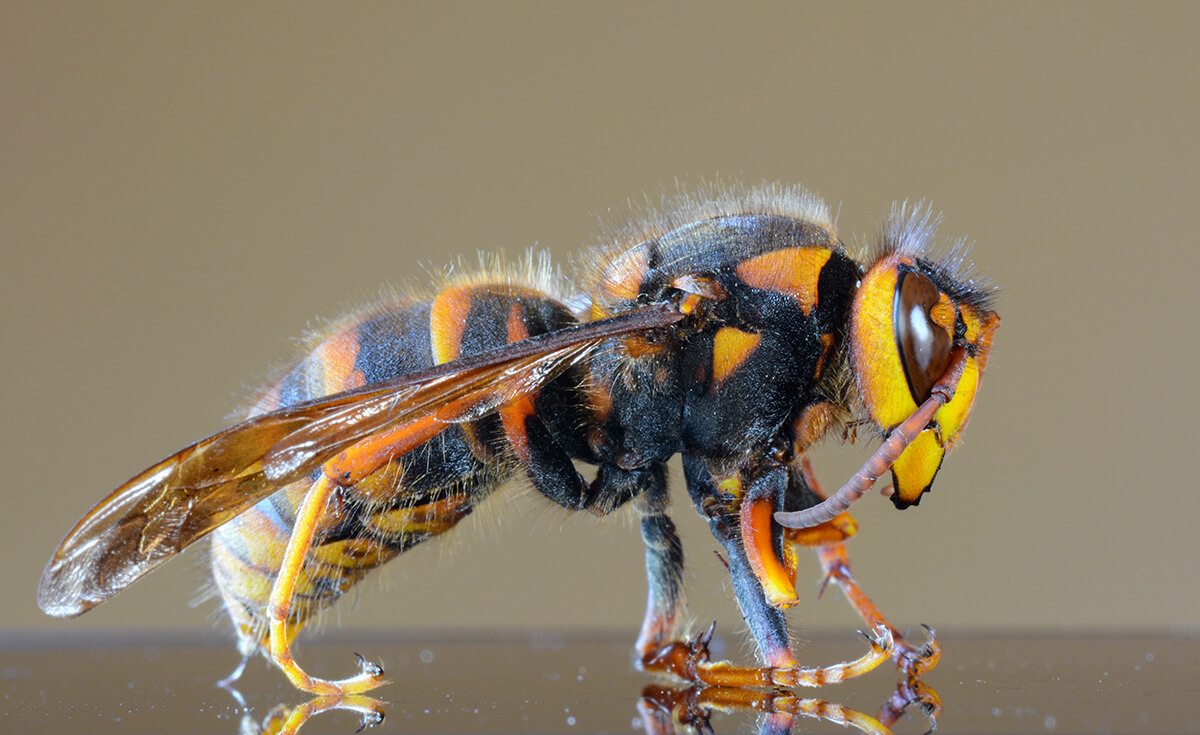
Hornets are technically a type of wasp, but they are larger and often more intimidating than yellow jackets. Most hornets in the Mid-Atlantic region build large, enclosed paper nests high in trees, under rooflines, or attached to homes and sheds.
Hornets are social insects that live in organized colonies with queens, workers, and drones. While they generally won’t sting unless provoked, disturbing a hornet nest can trigger an aggressive swarm response.
Their stings are painful and may be dangerous for anyone with allergies to stinging insects. Because hornet nests are often located high above the ground, attempting DIY removal can be especially risky.
Paper Wasps
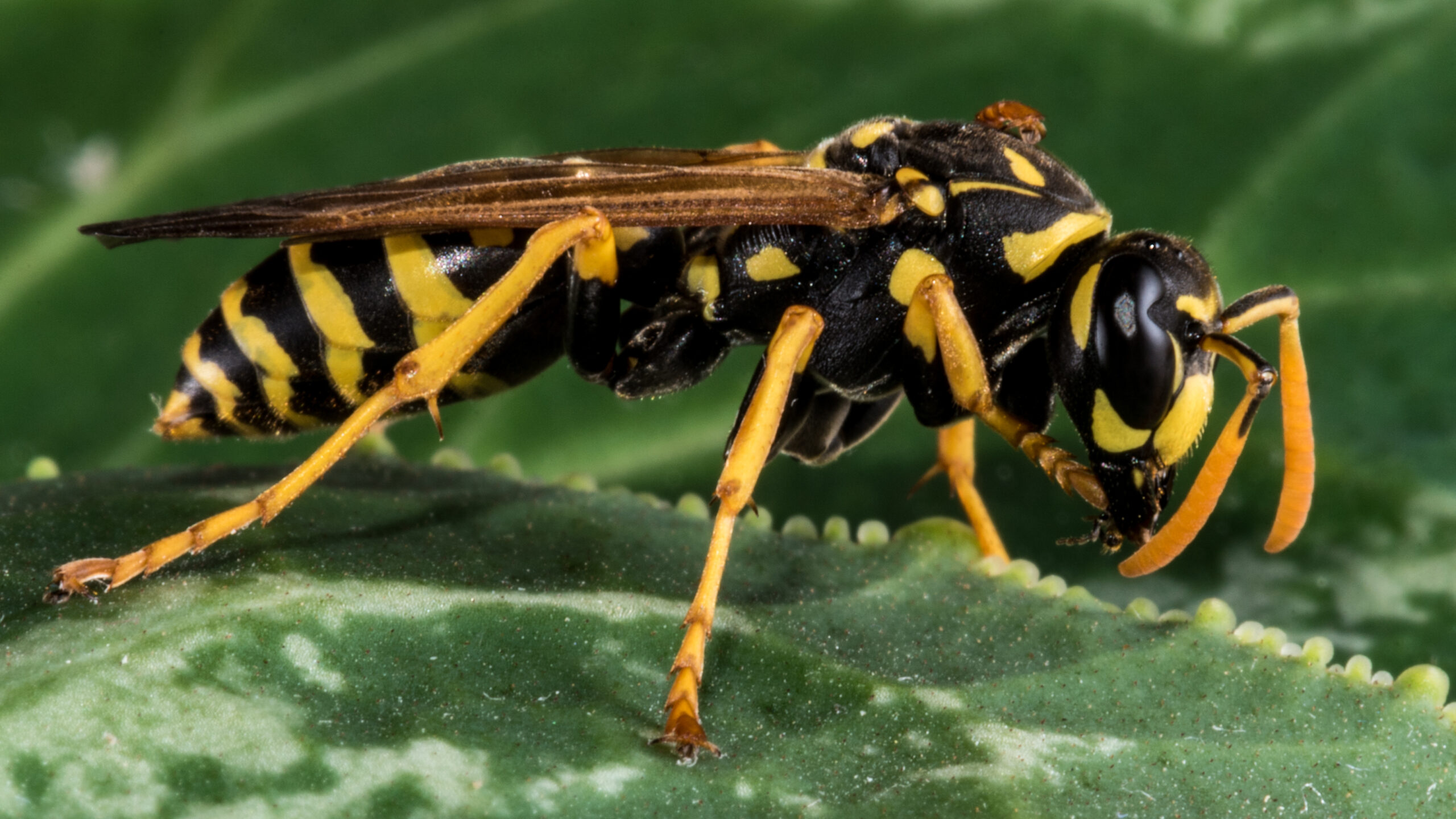
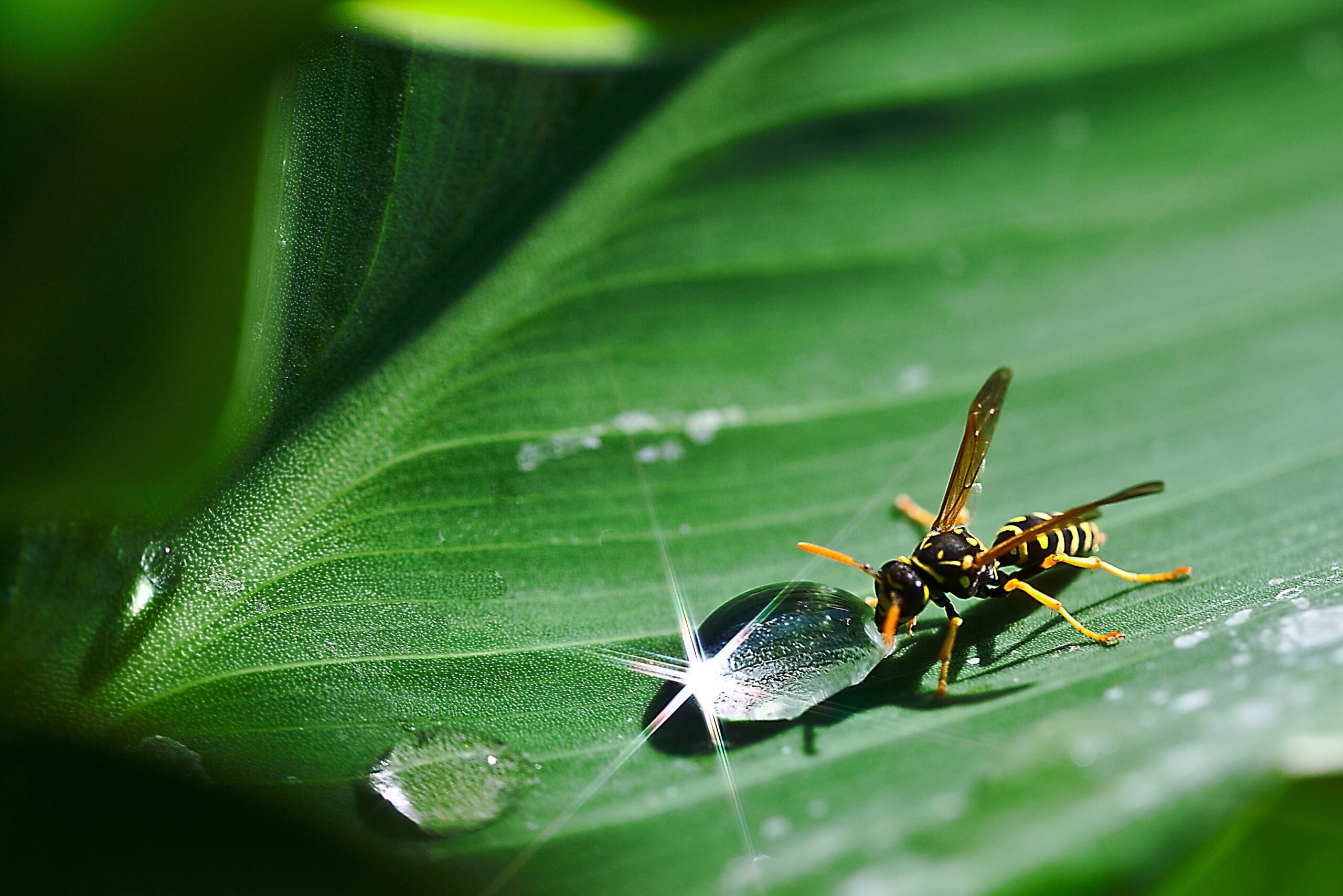
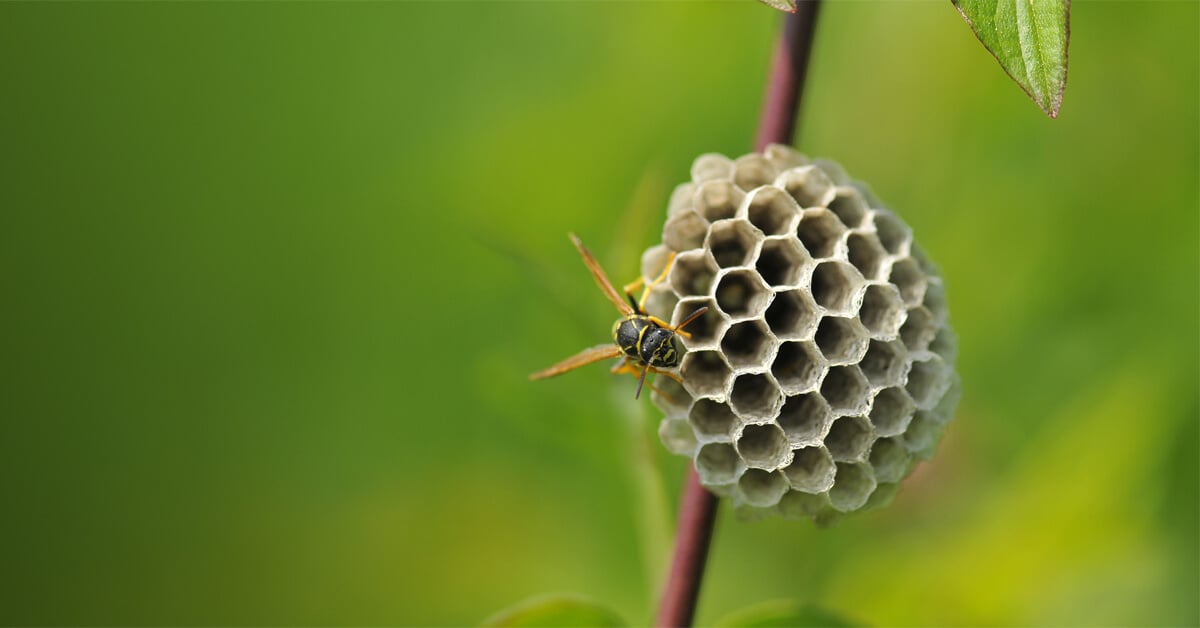
Paper wasps are slightly less aggressive than yellow jackets, but they can still sting when they feel threatened. These wasps are known for their long legs, slender waists, and brown or reddish coloring with yellow markings.
Their nests resemble upside-down umbrellas and are often found hanging beneath eaves, porch ceilings, railings, shutters, and deck structures. Paper wasps create these nests by chewing wood fibers into a paper-like material.
While paper wasps tend to be less confrontational away from the nest, they are very protective once someone gets too close to their colony.
Mud Daubers
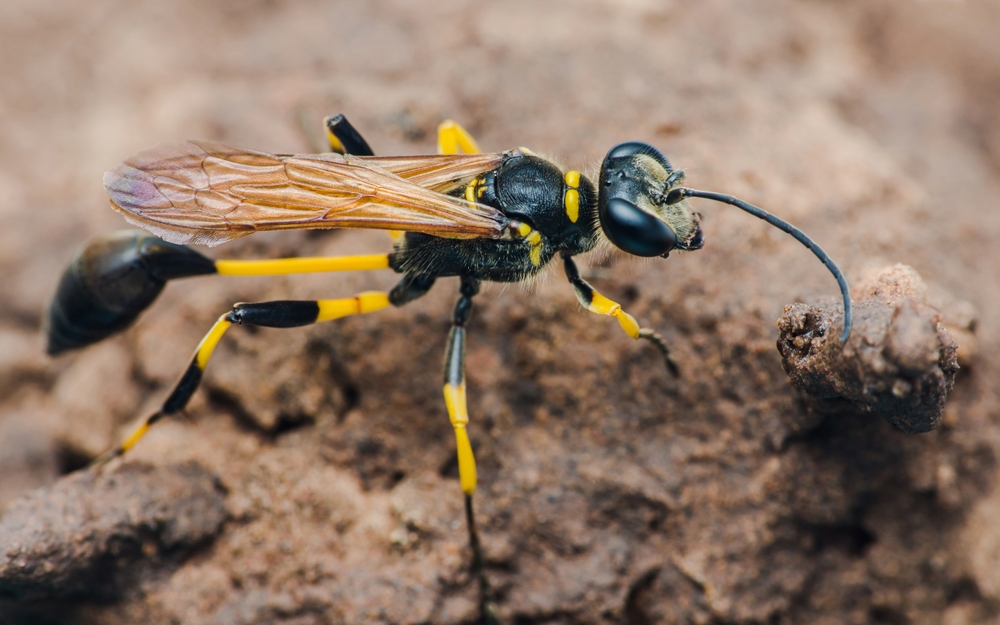
Mud daubers are one of the less aggressive wasps homeowners may encounter. These solitary wasps build small tube-shaped nests out of mud in garages, sheds, attics, under eaves, and along porch ceilings.
Mud daubers are recognizable by their long, thin bodies and metallic black or blue coloring. Unlike social wasps, they do not live in large colonies and rarely sting humans unless directly handled.
Although they are less dangerous than yellow jackets or hornets, their nests can still become a nuisance around the home.
Cicada Killers
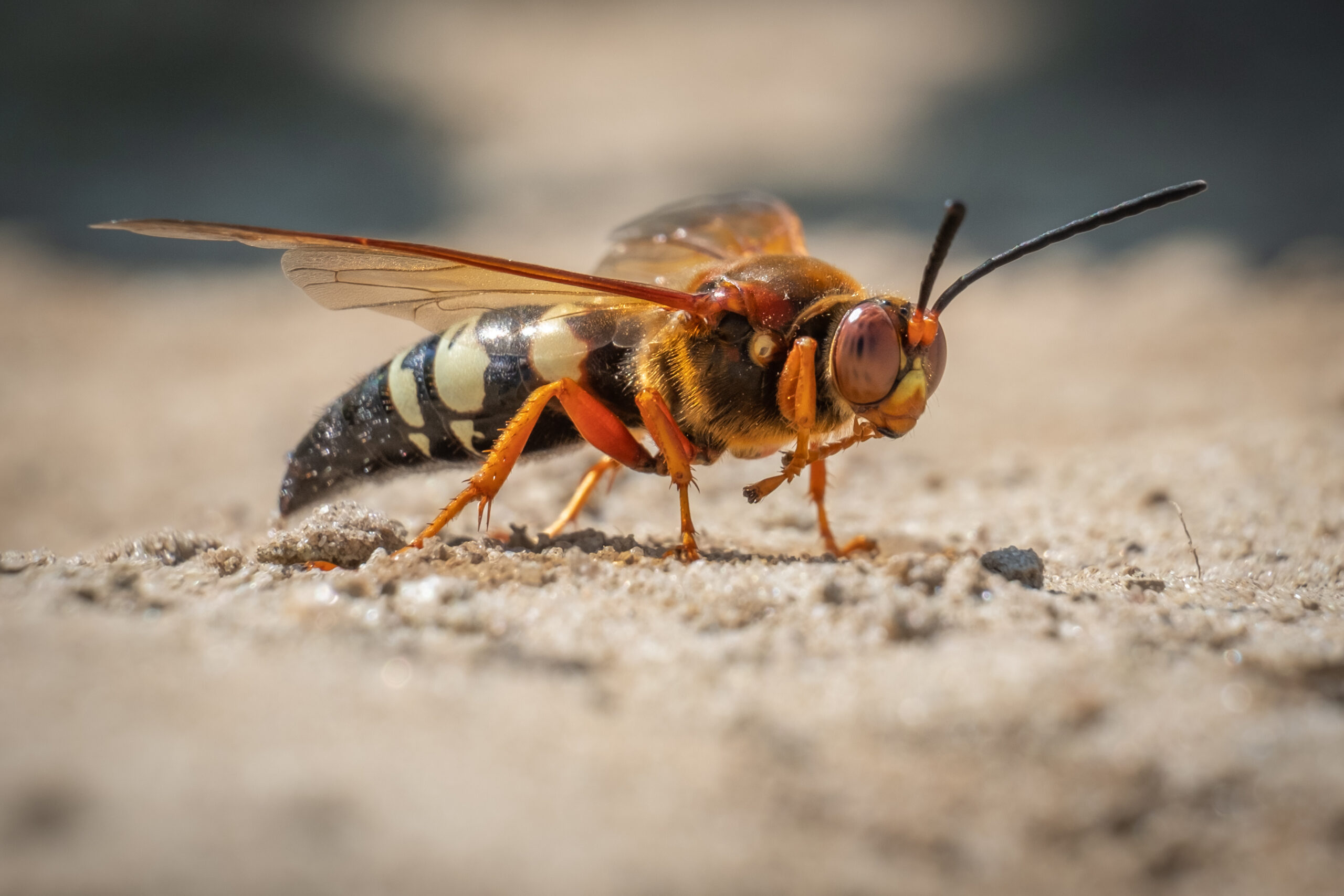
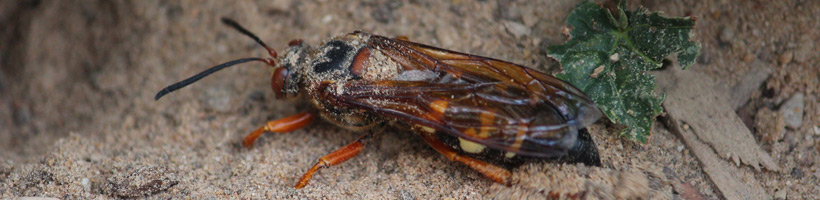
Cicada killers are large ground-nesting wasps commonly seen during the summer months. Despite their intimidating size, these wasps are generally not aggressive toward people.
Female cicada killers dig burrows in the soil and use paralyzed cicadas as food for their young. You’ll often spot them around bare patches of dirt, gardens, sidewalks, or landscaped areas.
Male cicada killers may appear territorial, but they do not have stingers. Females can sting but rarely do unless physically threatened.
Why Wasps Around Your Home Can Become Dangerous
While wasps do help control other insect populations, they become a serious concern when they nest near homes, patios, playgrounds, walkways, or outdoor gathering spaces.
Stinging insects can be especially dangerous because:
Many species can sting multiple times
Some wasps attack in swarms
Their nests are often hidden underground or inside structures
Stings can trigger severe allergic reactions
Aggressive species become more active in late summer and fall
Attempting to remove a nest yourself can quickly escalate the situation, especially with yellow jackets and hornets. DIY sprays often fail to eliminate the entire colony and may provoke surviving wasps into becoming even more aggressive.
How to Help Prevent Wasps Around Your Property
Homeowners can reduce the chances of attracting wasps by taking a few preventative measures:
Keep trash cans tightly sealed
Clean up fallen fruit and sugary spills outdoors
Avoid leaving pet food outside
Seal cracks and gaps around siding and rooflines
Fill ground holes that could become nesting sites
Trim overgrown shrubs and tree branches
Remove old nests during the winter months
Regular inspections around decks, eaves, sheds, and attics can also help catch nests before colonies grow larger.
Professional Wasp Control From Viking Pest Control
If you’ve noticed wasps flying around your property or discovered a nest near your home, it’s best not to take chances. Some species become extremely aggressive when disturbed, and removing nests without proper equipment can be dangerous.
Viking Pest Control has decades of experience helping homeowners throughout New Jersey, Pennsylvania, Delaware, and the Eastern Shore of Maryland safely eliminate wasps, hornets, yellow jackets, and other stinging insects. Our trained technicians can identify the species, locate hidden nests, and provide safe, effective treatment solutions designed to protect your family and property.
Call Viking Pest Control at 800-618-2847 to learn more about professional wasp and stinging insect control services, or get a fast, free quote online today!
How to Get Rid of Flies
If you feel like you're waging (but losing) the war on flies in and around your home, you're not alone. There are more than 16,000 known species of flies in North America alone, all of them annoying.
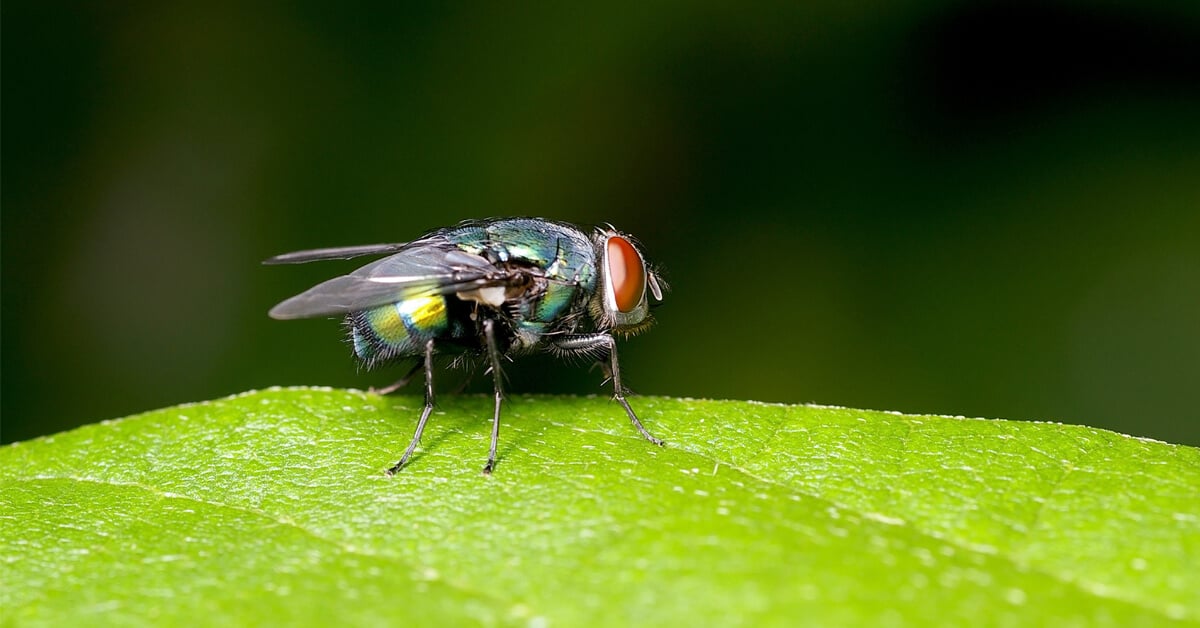
Flies are more than just an annoyance—they also pose a risk to human health. Flies carry microorganisms that can cause medical problems ranging from diarrhea and bloodstream infections to meningitis. Dozens of pathogens are closely associated with fly infestations, including E.coli, staphylococcus, and salmonella, as are diseases such as hepatitis, cholera, and typhoid fever.
Flies are a common nuisance during the warmer months of the year, with fruits flies, houseflies, and sewer flies being among the most common types of flies that plague New Jersey, Delaware, Pennsylvania, and Maryland homeowners. While particularly bad infestations of flies, especially fruit flies, require professional pest control help and the expertise of a seasoned exterminator, learning how to get rid of flies yourself can be useful in some situations.
First Things First: Where Are the Flies Coming From?
Although flies can breed indoors, most get their start outside. For that reason, it makes sense to find the source of the flies afflicting your home before you formulate a battle plan to defeat them.
Flies are attracted to any type of organic matter, especially if it's in a state of decay or decomposition. This means that flies are naturally drawn to your compost pile outback, any type of animal waste, and any sort of rotting fruit or vegetables.
Eliminate flies' happy spot – the spot where they can lay thousands of eggs - and you will see the fly population reduced dramatically. In fact, with the proper steps outdoors, you will have fewer problems controlling flies indoors. Failing to take outdoor fly control into account will undermine successful efforts to curtail the local fly population inside as well as out.
Some more tips for outdoor fly control:
Keep it clean. Begin with your trash cans. Make sure that you use a bleach solution to clean out your trash cans regularly, and keep any type of compost pile or compost bin as far away from your home as possible. Cover your compost bin so that flies can't get inside. If you have pets, be mindful of picking up their waste out of the yard because flies love to blow piles of dog and cat feces.
Know that the enemy of your enemy is your friend. Make your backyard as welcoming as possible to flies' natural predators. Birdhouses and birdbaths attract more birds to your lawn, and birds love eating flies. If you are so inclined, consider attaching a bat house to your roof to attract bats, which are well-known for their capacity to nosh on these six-legged irritants. Depending on a bat's life stage, it can eat up to 4,000 insects in a single night.
Learn to be a bad host. There are certain things that flies detest, and one of those things is pine cleaner. If you have an outdoor fly infestation, which means sooner or later you're going to have an indoor fly infestation, cleaning your porch, patio and siding with pine cleaner is a big detractor to flies. Before attempting this, be sure to test and a noticeable area of your porch or patio to make sure that you do not damage the wood or other materials that it's made from. repeat the application of pine cleaner every few days until the flies realize that your home is an inhospitable environment for them.
Try natural fly deterrents. Flies are also not a fan of certain types of essential oils. Create a DIY fly deterrent spray using a few ounces of essential oils to every gallon of water. Scents that flies hate the most include citronella, rosemary, eucalyptus, lemongrass, mint, lavender, and clove. Another option is to put a few drops of essential oils of your choice on strips of old cloth and hang them near doors and windows or other areas where flies tend to find their way inside.
Indoor Fly Control and Prevention
Inside the home there are several measures that you can take to make your home appear less appealing to flies. First, do your best to keep flies out in the first place by keeping doors and windows shut when possible. Inside cover all food keep trash in a tightly sealed can and clear away any food debris after cooking and serving meals. The goal is to give the flies that come into your home nothing to hey deal find appealing about your home.
Keep a flyswatter on hand to deal with occasional flies that find their way into your home. If you notice a particularly large number of flies coming inside, you can try sticky strips of flypaper, which are available for sale at most big box retailers or hardware stores.
Professional Fly Extermination
The rate at which flies reproduce is nothing short of shocking and underscores the need for effective pest control and a timely call to the exterminator. Take the common fruit fly, which is a particularly bothersome pest in New Jersey. The fruit fly gets its name from its attraction to overly ripe fruits and vegetables, which is also where it likes to lay its eggs. A single female fruit fly lays hundreds of eggs in a very, very short span of time. The eggs that she lays turns into little maggots and those maggots turn into grown flies over the course of just a few weeks. This means that a domestic fruit fly infestation can quickly get out of hand if you don't take steps to control it.
While DIY methods of fly extermination are okay in some instances, calling a professional exterminator is usually the most expedient option to help you get rid of these irritating winged critters. Viking Pest Control is ready to buzz on over to your home to help. Our team is trained in the management and extermination of flies and have proven methods to take care of the little buggers once and for all, including the use of treatments and products that send flies packing. Reach out now - we're ready and eager to help you find a solution for your fly problem.
For a free fly control quote call Viking Pest at (800)618-2847 or visit vikingpest.com.
How to Get Rid of Cicada Killers, Mining Bees, and Other Ground Bees
What options do home and business owners have for safely and permanently eliminating large populations of cicada killers and ground bees that live rent-free in their yards?
Although cicada killers, mining bees, ground bees, and other stinging insects pollinate plants and aerate the soil, nobody wants a large population of them right outside their back door. People who are allergic to bee or wasp stings could suffer anaphylactic reactions (facial swelling, difficulty breathing, rapid heartbeat).
Also, it's no fun to hold backyard get-togethers or sit on your front porch in the evening when the chance of a bee or wasp attack is all too real. If you're a business owner, customers won't enjoy being chased by buzzing, irate bees while attempting to enter your building.
If you try any of the following bee-eliminating methods, be aware they do involve getting perilously close to bees. For the most part, bees will leave humans alone but when they sense someone invading their personal space--look out! Your risk of suffering a sting or two--or three-- increases dramatically.
Why not play it safe and let Viking Pest handle your bee infestation issues? We use the most effective treatments available to rid your property of stinging cicada killers and ground bees so you don't have to take a chance on riling up (literally!) a hornet's nest.
How to Get Rid of Cicada Killers
A large species of wasp with black, yellow-banded bodies and orange wings, cicada killers can capture cicadas in mid-air and paralyze them with venomous stings. However, cicada killers rarely sting humans unless they are aggressively provoked. But, if you are stung by a cicada killer, the pain and swelling it causes will likely require a doctor's attention.
As diggers and tunnelers, cicada killers can destroy plant root systems and make landscape ground unstable. Getting rid of a cicada killer infestation involves targeting the holes they make in the ground:
After dark, pour boiling water into holes and place containers over the holes. Wasps will either drown or suffocate while trapped under containers. However, boiling water won't kill eggs.
Pour boric acid into holes. While boric acid kills eggs and adult wasps, it won't prevent another group from returning next year.
How to Get Rid of Mining Bees
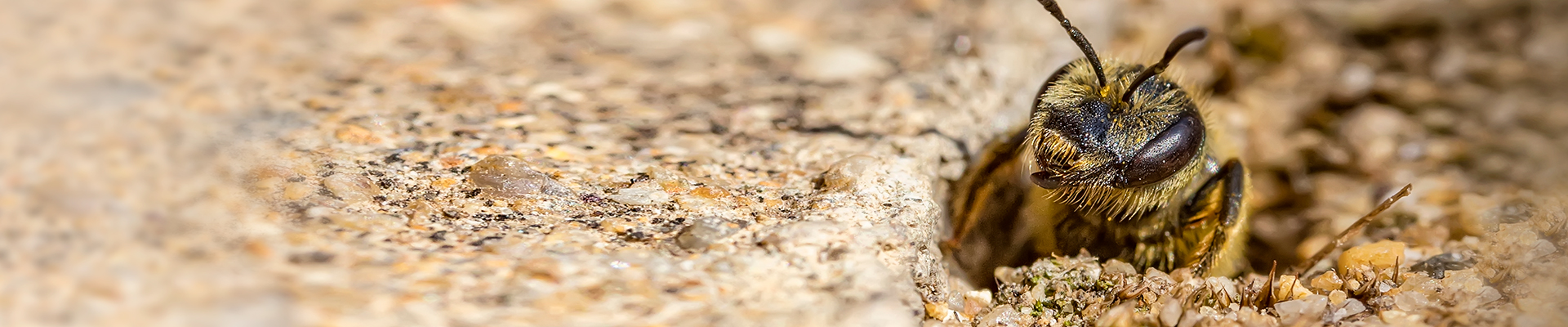
Female mining bees excavate burrows underground in which to lay their eggs. They leave behind mounds of dirt nicknamed "soil volcanoes" that may look like molehills with a hole at the top of the "hill". Although brushing down these soil volcanoes won't get rid of mining bees, they will leave your lawn or garden free of soil volcano eyesores, but only temporarily.
You can try to rid your yard of mining bees by:
Growing geraniums, marigolds, lavender, and other bee-repelling plants around your yard
Letting your lawn remain thicker than normal during spring and summer. Mining bees tend to gravitate towards sparser areas of grass where it is easier to dig into the ground.
Trapping them by placing a stone or brick over the entrance to their burrow.
Although the sting of a mining bee is less painful than the sting of a cicada killer, people who are sensitive or allergic to bee stings could experience serious medical issues if stung by a mining bee.
How to Get Rid of Other Ground Bees
Most bees don't build mud or paper nests under a building's eave or in trees. In fact, 70% of all bee species build nests underground. One of the most common ground bees in the midwestern and northeastern areas of the U.S. is called Colletes inaequalis.
It's a solitary bee but females are famous for their sociable nesting behavior. Hundreds or even thousands of female C. inaequalis bees will build their nests right next to each other, as long as there is enough suitable ground that accommodates their gregariousness.
Methods for discouraging a ground bee takeover of your property include:
Making the ground less attractive to females by irrigating heavily and placing mulch or another ground cover where grass is sparsest.
Mix equal parts vinegar and water and spray where ground bees are nesting. Always wear protection when spraying ground bees with vinegar and water. This spray doesn't provide a contact-kill and will initially agitate them.
Bug zappers won't exterminate the entirety of a ground bee city but may help minimize a large ground bee population.
If Nothing Works to Rid Your Home or Business of Soil Volcanoes and Stinging Bees...
Contact Viking Pest for professional solutions to your most difficult bee problems. Like other insects, a bee's determination to procreate and make thousands of other little bees is often more powerful than bespoke bee repellant. That's why we've developed evidence-based treatments to resolve your most bewildering bee brain-teasers.
Call Viking Today at 800-618-2847 today for professional pest control services or visit us at vikingpest.com.
Spotted Lanternfly Damage... And What to Do About It
In just seven years, the spotted lanternfly has spread from a small section of Pennsylvania to nine U.S. states. But would you recognize one if you saw it? What if it started damaging your home?
Spotted lanternfly damage is affecting agricultural businesses and homes alike as these bugs terrorize the Northeast United States. If you haven't heard about lanternflies yet, or are aware of the devastation this pretty little monster can wreak on plant life, it's time to educate yourself on this invasive pest. Keep reading to learn more.
What Is the Spotted Lanternfly?
The spotted lanternfly is a fairly recent invasive insect species to the US. This bug is native to China, India, and Vietnam but came to the US in 2014. An egg sack was probably carried over on a shipping container, and these multi-legged menaces have been terrorizing US trees and crops and expanding their destructive rampage across the states since their arrival.
The Spotted Lanternfly was first documented in Pennsylvania, but it can now it can also be found in New Jersey, Delaware, Maryland, New York, Connecticut, and even Virginia. Spotted lanternflies were able to spread so quickly because they will lay their eggs on almost any surface. It's very easy for people to bring lanternfly egg sacks to new locations on their cars without even realizing it.
What Is Spotted Lanternfly Damage?
All life stages of spotted lanternflies present a risk of damage to plants and crops. They pierce plant tissue with their mouths and drain them of vital fluids. The younger stages tend to damage tender plant life, while adults are able to pierce through the bark of trees during feeding.
In the US, spotted lanternflies pose a threat to economically important plant life including grapevines, blueberry bushes and apple, peach, maple, walnut, and pine trees. Many farmers have resorted to extreme methods to protect their crops against lanternflies, some of which can be damaging to pollinator bugs as well as expensive for businesses.
Even worse than the damage they do while feasting on plants is the damage they do when defecating. Lanternfly “honeydew” is a sticky substance that they secrete after eating. This goo invites other pest insects to the same tree and develops a fungus that can damage its root system.
How Do I Identify Spotted Lanternflies?
It's clear that the lanternflies need to be stopped. But if you don't know what they look like how can you stop them? It's important that everyone in the lanternfly's current area be able to identify them at all life stages. While the distinctive spotted red and white wings of the adult lanternflies are quite distinctive, their previous stages of development aren’t as easily recognized.
It's especially important to respect the spotted lanternfly quarantine. This means that you should be inspecting your car for egg masses so that you don't bring them into new territories.
Here's a helpful guide.
Eggs
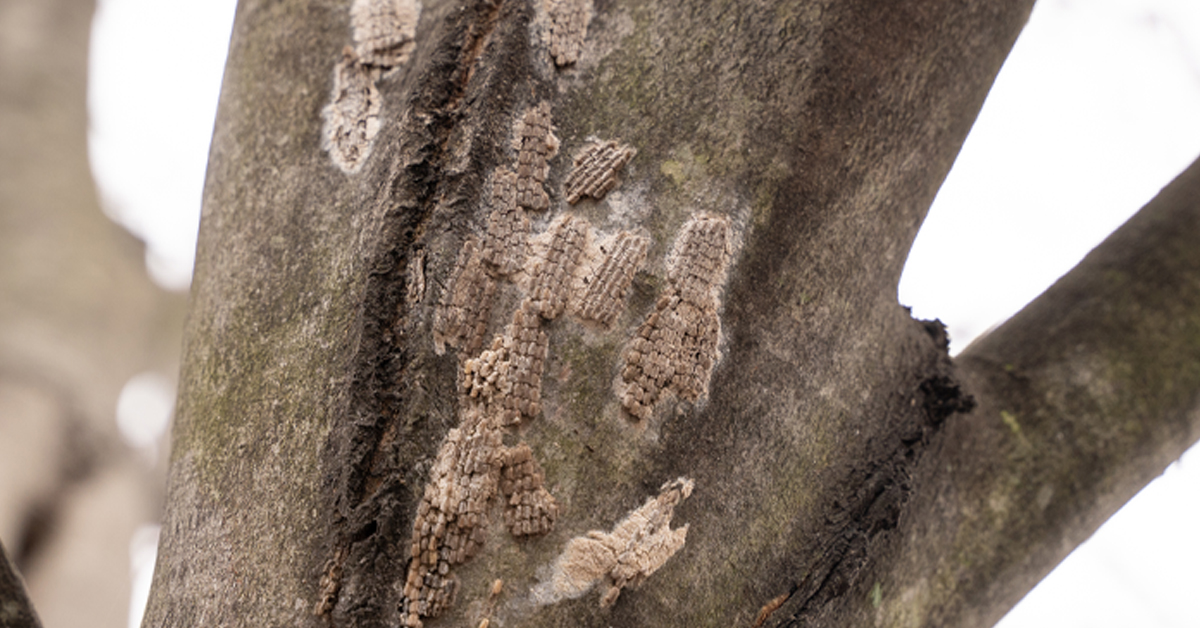
Spotted lanternfly egg masses start appearing in the fall season. Lanternflies will lay their eggs on any hard surface - from cars to playground sets, trees, and patio furniture. They're very hard to spot because of their coloring, and because a lot of other things look like them.
When dry, the egg masses look like cracked mud packed onto a surface. They're about one square inch all the way around. Each mass contains up to sixty lanternflies inside. That's a lot fewer lanternflies if you can identify a mass and destroy it.
Nymphs
Lanternfly nymphs come in two stages. They start hatching in the spring, and their first stage is quite small. They look like little black beetles with white polka dot spots. They are wingless and grow to be about a quarter of an inch long.
In the midsummer, those early nymphs will go through a molting process and start to show their second stage of nymph-hood. These so-called "red-stage nymphs" are strong enough to start breaking through the bark of trees and causing damage.
The red-stage nymphs are slightly bigger averaging at about three-quarters of an inch long. They maintain their white spots but develop a striking, bright red body and black markings like stripes. They'd be quite pretty to look at if they were such a menace.
Adults
Also around midsummer, the adult lanternflies start appearing and they'll last until it starts to frost in the fall.
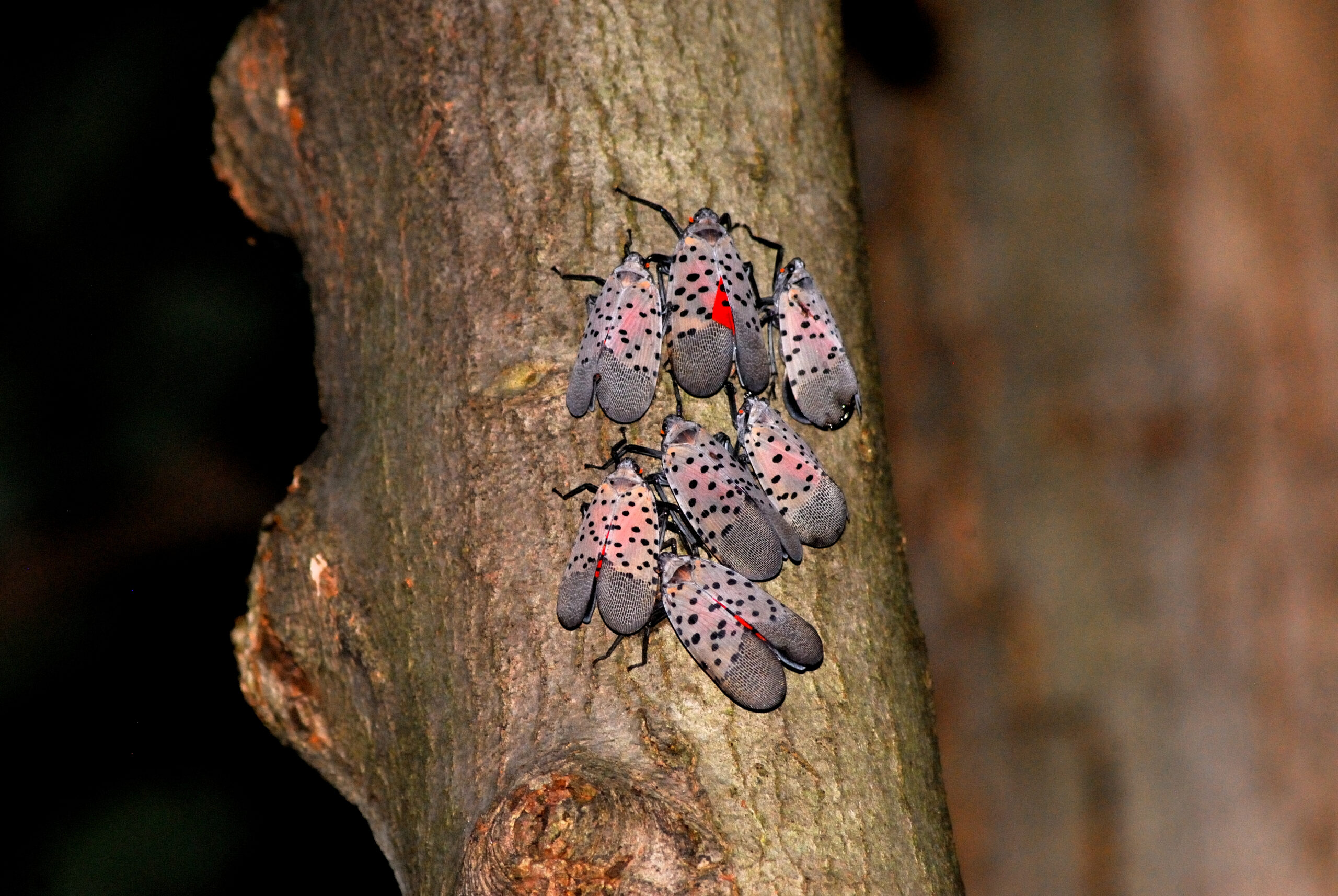
The adults are about an inch long and half an inch wide. They have a pink, tan, or brownish outer wing covered with little black spots (hence the spotted name). They look a little bit like a mix between a moth and a cicada and have quite papery wings.
The greatest indicator that you're looking at a spotted lanternfly is the bright red underwing. You won't see it unless they get disturbed and fly or jump (like a grasshopper) but then it's impossible to mistake that unique bright red color.
Spotted Lanternfly Control in NJ, PA, DE, and MD
It's up to all of us to do our part to stop the spread of the spotted lanternfly.
As mentioned before, check your car before any road trips for egg masses, especially in the Fall. Remove them and then put them in a bag filled with alcohol to be sure that all the eggs are killed. Viking offers free spotted lanternfly egg scrapers.
If you see any stage of nymphs or adult lanternflies, squash them with your foot! They're quite fragile and there's no harm in killing them one by one.
Lanternfly Infestation? Call Viking Today!
If you start seeing more and more lanternflies in your backyard and discovering that sticky honeydew on your trees, you may have a full infestation.
Don't let lanternflies continue to breed in your yard and cause damage to your valued trees and plans. Call an exterminator to take care of the problem once and for all.
We can all do our part to stop the invasion of spotted lanternflies and put an end to spotted lanternfly damage. Check your car for egg masses, kill them on sight, and call an exterminator to deal with larger infestations.
Have you noticed nymphs in your yard? Check out our service for spotted lanternfly egg removal!
How to Get Rid of a Wasp Nest Safely
Nothing ruins time outside faster than discovering a wasp nest near your home. Whether they’re hovering around your deck, nesting under your roofline, or swarming near your yard, wasps can quickly become a serious safety concern for homeowners throughout New Jersey, Pennsylvania, Delaware, and the Eastern Shore of Maryland.
Unlike bees, wasps can sting repeatedly and often become aggressive when they feel threatened. Some species, especially yellow jackets and hornets, may even attack in swarms. Because of this, removing a wasp nest is not something homeowners should take lightly.
Before attempting DIY wasp removal, it’s important to understand the risks, how to identify the type of wasp you’re dealing with, and when it’s safest to call a professional.
Why Wasps Around Your Home Are Dangerous
While wasps do help control some insect populations, they become a major problem when they build nests close to people.
Wasps can:
Sting multiple times
Become aggressive when disturbed
Swarm to defend their nest
Trigger dangerous allergic reactions
Build nests inside walls, attics, soffits, and rooflines
During late summer and early fall, wasps become even more aggressive as food sources begin to disappear. This is when many homeowners first notice large numbers of wasps around trash cans, outdoor meals, gardens, and entryways.
Common Types of Wasps and Stinging Insects
Correctly identifying the insect is important because nesting habits and aggression levels vary significantly.
Yellow Jackets
Yellow jackets are among the most aggressive stinging insects homeowners encounter. They are black and yellow, about half an inch long, and often build nests:
Underground
Inside wall voids
Under decks
In shrubs
Around structures
Their colonies can become very large and highly defensive.
Paper Wasps
Paper wasps are slightly larger with long, slender bodies and orange-tipped antennae. They create umbrella-shaped paper nests commonly found:
Under eaves
Porch ceilings
Deck railings
Tree branches
They are generally less aggressive unless their nest is disturbed.
Hornets
Hornets are larger than typical wasps and build large hanging nests made from wood pulp. Their nests are commonly found:
In trees
On utility poles
Under rooflines
Near sheds or garages
Hornets can become extremely aggressive if approached.
Mud Daubers
Mud daubers are less aggressive solitary wasps that build small mud nests on walls, garages, sheds, and ceilings. While intimidating in appearance, they rarely sting unless handled directly.
Signs You May Have a Wasp Nest
Homeowners often discover wasp problems after noticing:
Increased wasp activity around the home
Buzzing sounds in walls or attics
Wasps entering and exiting small openings
Hanging paper nests
Underground insect traffic
Wasps gathering near trash cans or outdoor food
Observing flight patterns during the daytime can often help identify where the nest is located.
Why DIY Wasp Nest Removal Can Be Dangerous
Many homeowners attempt to remove nests themselves using store-bought sprays or homemade remedies. Unfortunately, this often leads to painful stings or larger infestations.
Some of the biggest DIY risks include:
Wasps swarming during treatment
Falls from ladders while spraying nests
Wasps entering the home through wall voids
Incomplete elimination of the colony
Exposure to pesticides
Harm to pets or children
Wasps also release alarm pheromones when threatened, which signals nearby colony members to attack.
Even at night, when wasps are less active, disturbing a nest can trigger an aggressive response within seconds.
How to Help Prevent Wasps Around Your Home
While prevention cannot guarantee wasps stay away entirely, it can greatly reduce the chances of nesting near your home.
Seal Entry Points
Inspect your home for:
Cracks and gaps
Open soffits
Damaged siding
Gaps around roofing
Openings near vents and utility lines
Wasps can squeeze into surprisingly small spaces.
Eliminate Food Sources
Wasps are attracted to both proteins and sugary foods depending on the season.
To reduce attraction:
Keep trash cans sealed tightly
Clean outdoor eating areas promptly
Pick up fallen fruit
Avoid leaving pet food outside
Cover drinks during outdoor gatherings
Maintain Your Yard
Reduce nesting opportunities by:
Filling ground holes
Trimming shrubs and tree branches
Removing yard debris
Inspecting sheds and playsets regularly
Use Wasp-Repelling Plants
Certain plants may help discourage wasps near patios and entryways, including:
Citronella
Spearmint
Thyme
Eucalyptus
Wormwood
Should You Remove a Wasp Nest Yourself?
Small, easily accessible nests may sometimes be removed safely with proper protective equipment and extreme caution. However, homeowners should never attempt DIY removal if:
The nest is large
The nest is inside walls or attics
You are allergic to stings
The nest is difficult to access
The insects appear highly aggressive
Children or pets are nearby
Professional pest control technicians use specialized protective equipment, treatment methods, and safety procedures designed to eliminate wasp colonies effectively and safely.
Professional Wasp Control in NJ, PA, DE, and MD
If wasps are nesting around your home, don’t put yourself at risk trying to handle the problem alone. Viking Pest Control provides safe, professional wasp and stinging insect control throughout New Jersey, Pennsylvania, Delaware, and the Eastern Shore of Maryland.
Our trained technicians can identify the species, locate hidden nests, safely eliminate active colonies, and help prevent future infestations around your property.
Call Viking at 800-618-2847 to learn more about wasp pest control and extermination services, or get a fast, free quote online today!
Protect Yourself with Award-Winning Mosquito Control from Viking
Mosquito populations are increasing rapidly across the United States, making mosquito control more and more of a priority for home and business owners. Luckily, Viking Pest offers award-winning mosquito protection to New Jersey, Pennsylvania, Delaware, and the Eastern Shore of Maryland residents.
Did you know that as many as 1 million people die from a mosquito-borne disease each year?
Fortunately, most of the most dangerous mosquito-borne diseases are found on the other side of the Atlantic. However, hundreds of US Citizens still contract serious diseases like West Nile Virus from mosquito bites yearly. Learn the how’s and why’s of keeping your family safe from Mosquitos in this blog.
200494427
Why Worry About Mosquitos?
The main reason mosquitoes are so dangerous is how easily they spread diseases. Over 50% of the global population is currently at risk of contracting mosquito-transmitted ailments including
Zika
West Nile Virus
Dengue
Yellow fever
Malaria
Lymphatic filariasis
Chikungunya
Canine Heartworm
Even more concerning is that some of these diseases, such as West Nile Virus, are spreading faster than ever. And while most people infected by these diseases will survive, they can still suffer long-lasting adverse effects on their quality of life.
Mosquito Populations Are Growing
Another reason mosquitoes are a significant problem is that they reproduce rapidly. Human changes to land and natural ecosystems have led to a marked increase in mosquito numbers over the last decade. In some areas of the US, mosquito populations have increased as much as four-fold.
Moreover, mosquitoes reproduce quickly. A female mosquito lays around 100 eggs at a time. These eggs are relatively sturdy, face little threat, and can mature in as little as 8-10 days.
Mosquitoes Are Resilient
While there are many effective forms of DIY mosquito control, studies show that some are losing their effectiveness. Certain mosquitoes have developed resistance to DEET, which is a critical component in many bug sprays. Those mosquitos that no longer smell DEET have passed this trait on to their offspring, which then pass it on to the next generation.
If you have a population of mosquitoes around your home, you may want to investigate more comprehensive and effective mosquito control methods.
How to Prevent Mosquito-Borne Diseases
While there are a variety of preventative measures you can take to avoid mosquito bites, the only way to completely prevent mosquito-borne diseases is to avoid being bitten altogether. Here are some preventive techniques you can use to prevent mosquito bites and, by extension, mosquito-borne diseases:
Clothing: When going outside in an area with mosquitoes, wear long clothes that cover your skin.
Last Bite: Last Bite from Viking Pest Control is an excellent form of tick and mosquito protection for your property. It is an efficient outdoor treatment that prevents these insects from breeding. Forbes Home recently rated Viking as one of the best mosquito control companies in the country.
Time Your Activities: If you plan outdoor events, try to schedule them after dawn and before dusk, as these are the peak hours of mosquito activity.
Mosquito-Proof Your Home: Ensure all your windows have intact screens to prevent mosquitoes from entering. Don't leave doors or unscreened windows open!
Repellents: While some repellents are losing their efficacy against certain mosquitoes, you can generally still use repellents when spending time in mosquito-populated spaces to attract fewer mosquitoes and reduce your chances of contracting a disease.
Stay Safe From Mosquitoes with Viking Pest Control
Though small in size, mosquitos are the deadliest animals in the world. Applying these prevention strategies can protect yourself and your family from mosquito-borne diseases.
Viking is proud to offer award-winning treatment designed to control and prevent mosquitoes from invading your home or business effectively and efficiently. A top-five Forbes Home Best Mosquito Control Company, Viking is ready to protect your property against these invaders. Our use of Integrated Pest Management (IPM) techniques focuses on finding the core of the pest concern and controlling Mosquitos from the source. Get in touch with us today for your FREE and NO OBLIGATION estimate at 1-800-618-2847 or Schedule Online today!
What is Integrated Pest Management and is it Important?
Philadelphia has huge bed bug problems. Spotted lanternflies are destroying crops in Pennsylvania, Delaware, and New Jersey. Mosquitoes and ticks make thousands of Americans sick every year.
Pest control is an integral part of being a home or business owner to protect your property, family, customers, and employees. One of the best techniques for properly controlling pests throughout your New Jersey, Pennsylvania, Delaware, or Eastern Shore of Maryland home or business is to use a pest control company that practices Integrated Pest Management.
Wondering what an integrated pest management (IPM) system is? Keep reading! We've got everything you need to know about IPM pest control right here.
What is Integrated Pest Management?
Integrated pest management sprung from the concern in the 1950s that we were overusing pesticides. That overuse was not only damaging to our health and environment but was also causing some species to become resistant to insecticides.
IPM is a holistic approach to pest management. It involves a partnership between the customer and their pest management company combined with practices to reduce the use of pesticides while still effectively destroying and preventing infestations.
IPM helps reduce costs, property damage, and potential health problems.
How IPM Works
There are five key elements to integrated pest management. Each element is customized to meet the unique needs of the customer.
1. Inspection
Your pest control management company conducts a thorough inspection of both the interior and exterior of your property. The inspection helps experts locate past or present infestations.
Pest management professionals also use this inspection to note if there are any conditions present that may attract future infestations.
2. Identification
Once your property has been inspected, pest control professionals can make a proper identification of any existing pests.
This will help them determine the extent of the infestation, what factors caused their presence, and the best method to control, prevent, and eliminate the pests.
3. Prevention
The inspection also shows where pest control methods should be implemented. Eliminating their points of entry makes it more difficult for these pests to survive and thrive on your property.
Other measures to reduce and prevent infestations include:
Increasing sanitation
Employee training
Ongoing monitoring
Methods of exclusion are also carried out. This includes reducing clutter, getting rid of build-ups of vegetation and standing water, and filling all gaps and holes within the exterior and interior of all structures.
4. Control
A control plan is developed based on which pests were identified and what (if any) potential threats there are to your environment and current conditions. In the beginning, the focus is on physical and mechanical methods including:
Exclusion methods
Sanitation methods
Trapping
Non-chemical measures
IPM does use materials, but only when necessary.
5. Documentation
Proper documentation records validate the effectiveness of IPM. You can use the documentation to proactively manage your future pest risks.
It's easy to apply this documentation since electronic reports are monitored and maintained 24/7 by your pest control service provider in a secure system.
What are the Benefits of Integrated Pest Management?
Why is IPM important? It's important because it works. And because it helps reduce the negative effects pesticides have on our environment and our health.
Here are a few other benefits of IPM:
It's a cost-effective program
Helps reduce public concern about our safety and the use of pesticides
Decreases public, tenant, and worker exposure to pesticides
Reduces ground-water and air contamination potential
Promotes sustainable bio-based pest control management options like Viking Green Pest Control
Encourages adoption of more ecologically-safe control practices
Reduces and eliminates pest re-entry
These benefits are one of the many reasons that IPM is continually growing in popularity.
What are the Impacts of IPM on the Environment?
Beginning in the 1940s, the use of pesticides helped to increase food production worldwide. Between 1950 and 2017, pesticide use increased by 11% every year.
By the year 2000, five million tons of pesticides were being used on an annual basis. Unfortunately, one side effect is that there were many cases of these toxic chemicals causing health problems in farmers, rural workers, and their families. IPM techniques focuses on finding the core of the pest concern and controlling pests from the source. Through IPM, pest control materials are selected and applied in a manner that minimizes risks to human health, pets, and the environment.
What Does IPM Mean for Your Home?
If you struggle with pest management in your home, it's time to contact the professionals. The pest control experts can properly identify what type of pest(s) live in and around your home.
They'll implement a strategy that is budget-friendly, safe, and effective. It's worth the peace of mind in knowing that your home is being monitored 24/7 for the presence of pests.
And you also know that if any are found, they'll be dealt with immediately. With IPM there are no unexpected and unpleasant pest infestations in your future.
What Does IPM Mean for Your Business?
Pest infestations can quickly destroy a business's reputation. This is especially true if you're in the food preparation business.
And it's not enough to spray materials and hope for the best. Professional exterminators are educated on what type of materials to use, how much to use, and when to use them.
A layperson can easily make a mistake and end up harming individuals. Keep yourself, your customers, and your employees safe from the problems that pest infestations bring.
Let Viking Implement an IPM for You Today
Whether it's for your home or your business, an integrated pest management strategy will ensure you're always pest-free. And we can help.
Viking Pest is the best choice in pest control practicing IMP techniques throughout New Jersey, Pennsylvania, Delaware, and the Eastern Shore of Maryland. Get a fast, free quote online, or Contact us at 1-800-618-2847.