

Ant Control and Extermination Services
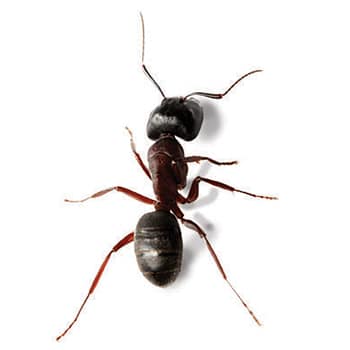
Viking Pest Control is the leading ant control company in New Jersey, Pennsylvania, Maryland, and Delaware. If you’re a local to our service area, you’ve probably seen or dealt with one of the many species of ants that reside in the Mid-Atlantic. Some of the most common ant species seen across these states include carpenter ants, pavement ants, Acrobat ants, odorous house ants, and citronella ants. To protect your home or business from ants, you need to understand their behavior, take preventive steps, and seek effective ant control treatments with Viking Pest if an ant infestation occurs.
Table of Contents
- What Are Ants?
- What Are the Effects of Ants In & Around My Home or Business?
- Flying Ants vs. Termites: What Are the Differences?
- How Do I Prevent Ants in My Home or Business?
What Are Ants?
Ants are among the most common insects across the globe, including New Jersey, Pennsylvania, Maryland, and Delaware. There are currently over 12,000 identified ant species worldwide, with a consensus that many more undiscovered species exist. In Maryland, New Jersey, Pennsylvania, and Delaware, there are several ant species that Viking primarily contends with. These pests are social insects that live in intricate underground communities, in trees, in wood structures, or in above-ground mounds of dirt.
While many ants live off a diet of nectar, fungus, and seeds, some can have unique diets that include birds, reptiles, and other small mammals. Ants are well known for attacking left-out food, trash, and crumbs. One of the most unique facts about ants is their ability to carry up to 5,000 times their body weight in food and materials for their living quarters!
“The vast majority of ants people actually see are sterile females,” says Craig Sansig, Public Health Entomologist and Viking Pest Vice President of Operations. “Within the insect world, only female ants are capable of stinging.”
How Do I Identify Ants?
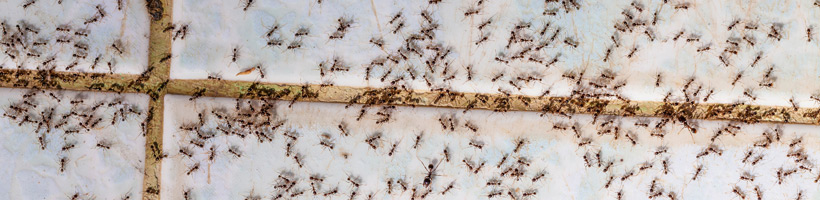
Ants are small, six-legged insects with bodies divided into three parts — a head, thorax, and abdomen. Most ants in New Jersey, Pennsylvania, Maryland, and Delaware are black, red, and/or orange. Pest control experts at Viking Pest explain that most likely, you won’t see ants alone, as they are social creatures that live together and work together to accomplish tasks like finding food and building their colonies. If you see a long line of insects traveling toward a food source, they’re most likely ants.
“People assume small ants are baby ants, but the juvenile stage of an ant is actually a larva and does not look like adults,” says Craig Sansig. “A small ant is just a small ant.”
Be careful, though, as ants do resemble termites and are often confused. Ant exterminators explain that the main differences between the two are that ants have much larger heads, their bodies narrow between the head and thorax, and they have antennae that appear to bend in the middle, like elbows.
How Did I Get Ants?
Ants tend to move frequently in search of food and water. While some of these food and water sources are within our control, others are not. As ants like to eat naturally occurring items like nectar, fungus, seeds, and some mammals, even the cleanest home or business in New Jersey, Pennsylvania, Maryland, or Delaware may be susceptible to an ant intrusion. Additionally, frequent moving can make it difficult to get rid of ants using DIY methods. The ant pest control experts at Viking Pest have extensive knowledge of the habits of the ant species found in New Jersey, Pennsylvania, Maryland, and Delaware, which is integral to ant extermination and control.
The experts at Viking explain that ants are cold-blooded insects, and their movement habits are greatly affected by the temperature. During the warmer months in Delaware, Pennsylvania, New Jersey, and Maryland, ants are frequently on the move in search of food, water, and new shelter. However, when the temperatures drop, ants look for areas to keep their internal temperature up.
Unfortunately, an unsecured home or building can seem quite inviting for an ant colony during the colder winter months. Just because ants are more active in the warmer months, it doesn’t mean you don’t run the risk of dealing with ants during the colder times of the year.
Types of Ants in NJ, PA, DE, & MD
There are several types of ants that invade homes and businesses throughout the mid-Atlantic area. Here is a list of the most common:
Acrobat Ants
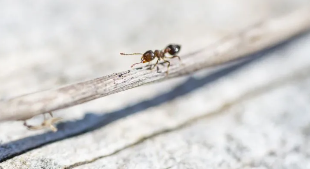
Acrobat ants have the greatest size range of any ant species. Workers range from 1/16 of an inch to double that size and can be brown to black.
The acrobat ant gets its moniker from its reaction to danger or surprise. When alarmed, it raises its abdomen (the rear-most section of the body) over its head and thorax in response to a threat.
Outdoors, acrobat ants tend to live where wood-destroying insects, like termites or carpenter ants, have abandoned nests. Inside your home, they tend to nest in areas with moist or damaged wood, like attics or crawl spaces.
These ants feed on honeydew sap and other common insects found in NJ, PA, DE, & MD. Like most species, they may enter homes in the mid-Atlantic region in search of food (though they prefer sweets).
Pavement Ants
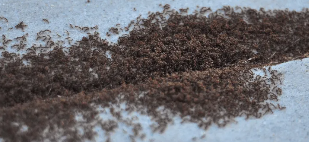
Pavement ants are named after the areas where they live. You can find pavement ants all around NJ, PA, DE, & MD. Workers are about 1/8 of an inch and move rather slowly compared to other ant species.
You can find pavement ants directly beside or near sidewalks, driveways, and your home’s foundation. Indicators of a nest are a mound of dirt along the edge or in a crevice of a hard surface.
Pavement ants also swarm in the warmer mid-Atlantic months and can be differentiated from termites by their “pinched waist,” as opposed to the more rectangular termite body type.
Outside your home in Viking’s covered service area, pavement ants tend to feed on other insects and honeydew sap. Inside your home, they will feed on a variety of pantry items.
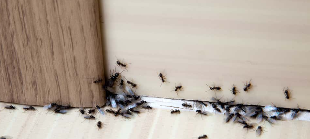
Odorous House Ants
A very common ant in NJ, PA, DE, & MD (with a very descriptive name) is the odorous house ant. They are named “odorous” because they exude a stench that smells like rotten fruit when you crush them.
In a single nest, they can have thousands of workers and multiple queens. This makes it harder to get rid of them because even if you kill one queen, the others can continue the colony. They grow to about 1/8 of an inch and are black to brown.
These ants are very adaptable and can make nests almost anywhere. They prefer to nest in your yard, in cracks in your siding or brick, and even in insulation. Odorous house ants are attracted to sweet ornamental flowers outside of the home, as well as sugary foods inside the home.
The best way to get rid of these ants is to reduce their access to food, water, and shelter. Make sure you properly dispose of even the tiniest bits of food, and never provide any access to water. Even a small leak can give odorous house ants enough moisture to survive, so ongoing ant control and monitoring are important to prevent future infestations.
For information on Carpenter Ants, please visit this page.
What Are the Effects of Ants In and Around My Home or Business?
Depending on the type of ants you’re dealing with at your home or business in NJ, PA, MD, or DE, the negative effects vary. Because house ants are so small and will travel through almost any environment, they can track garbage and filth and, consequently, unhealthy bacteria. While most smaller ants do not bite, larger ants, like carpenter ants, can. In the 1980s, 75% of urban shade trees sampled in New Jersey were infested with carpenter ants. Fast forward several decades, and the pests are still a problem in New Jersey, Maryland, Delaware, and Pennsylvania.
How Long Do Ants Live?
Throughout NJ, PA, MD, and DE, ants can live anywhere from a few weeks up to several years. Life span depends on the ant species, the conditions they live in, their exposure to natural predators, and their role within the colony. For example, the pest control experts at Viking Pest state that queen ants can live up to 30 years, while worker ants may live only a few weeks.
Flying Ants vs. Termites. What Are the Differences?
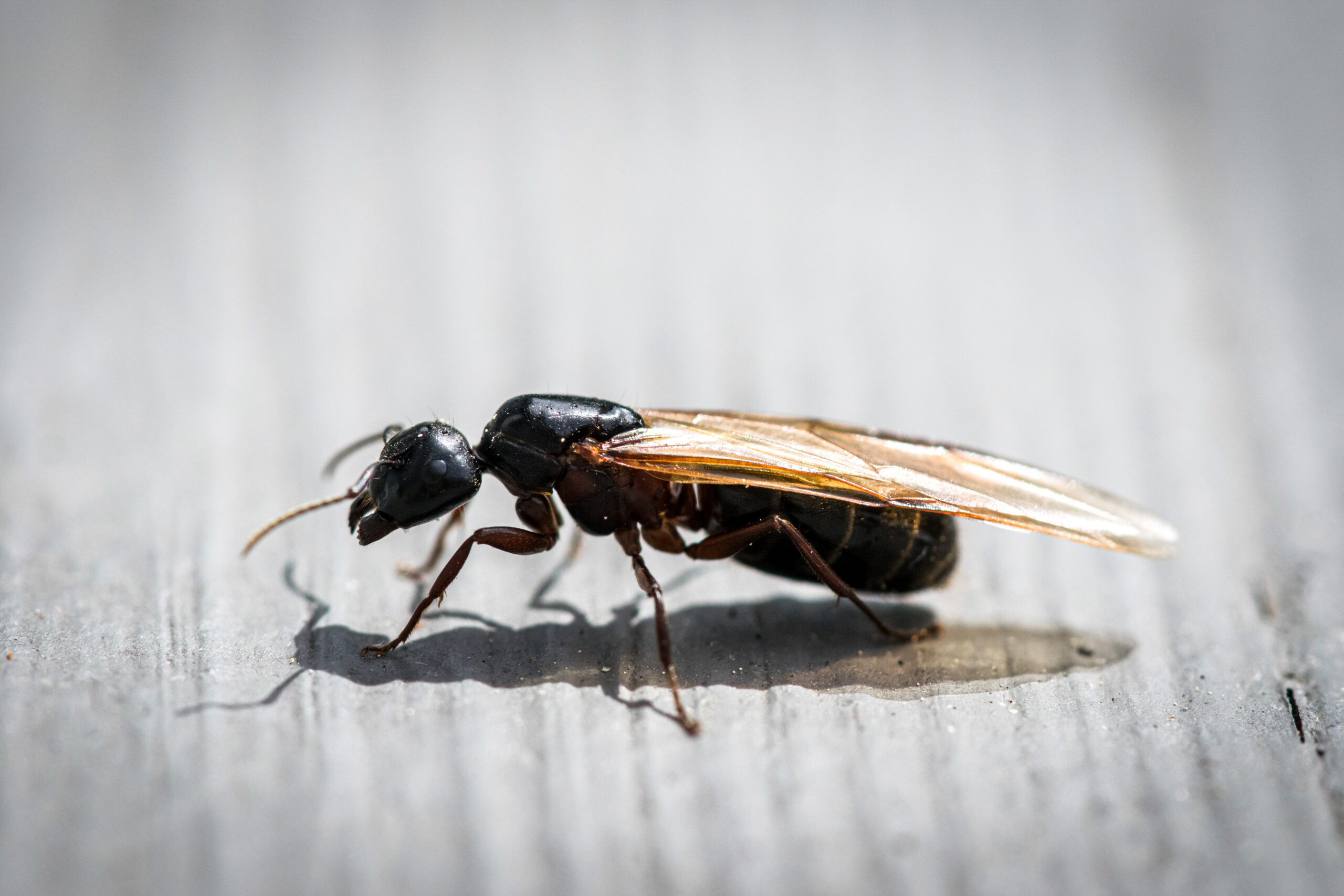
Flying ants are mature male and female ants whose sole purpose is to leave the ant colony and mate. These flying ants, also known as swarmers, leave when it is time for the ant colony to expand. Flying ants leave their colony as the weather begins to warm and humidity rises. You can expect to see groups of flying ants during the spring and early summer throughout New Jersey, Pennsylvania, Delaware, and the Eastern Shore of Maryland. Flying ants also tend to swarm in large numbers to deter predators. Once the male and female flying ants have mated, the male flying ant will die, and the female flying ant will find a place to nest and begin her own colony. This female flying ant will now be the queen ant of her colony.
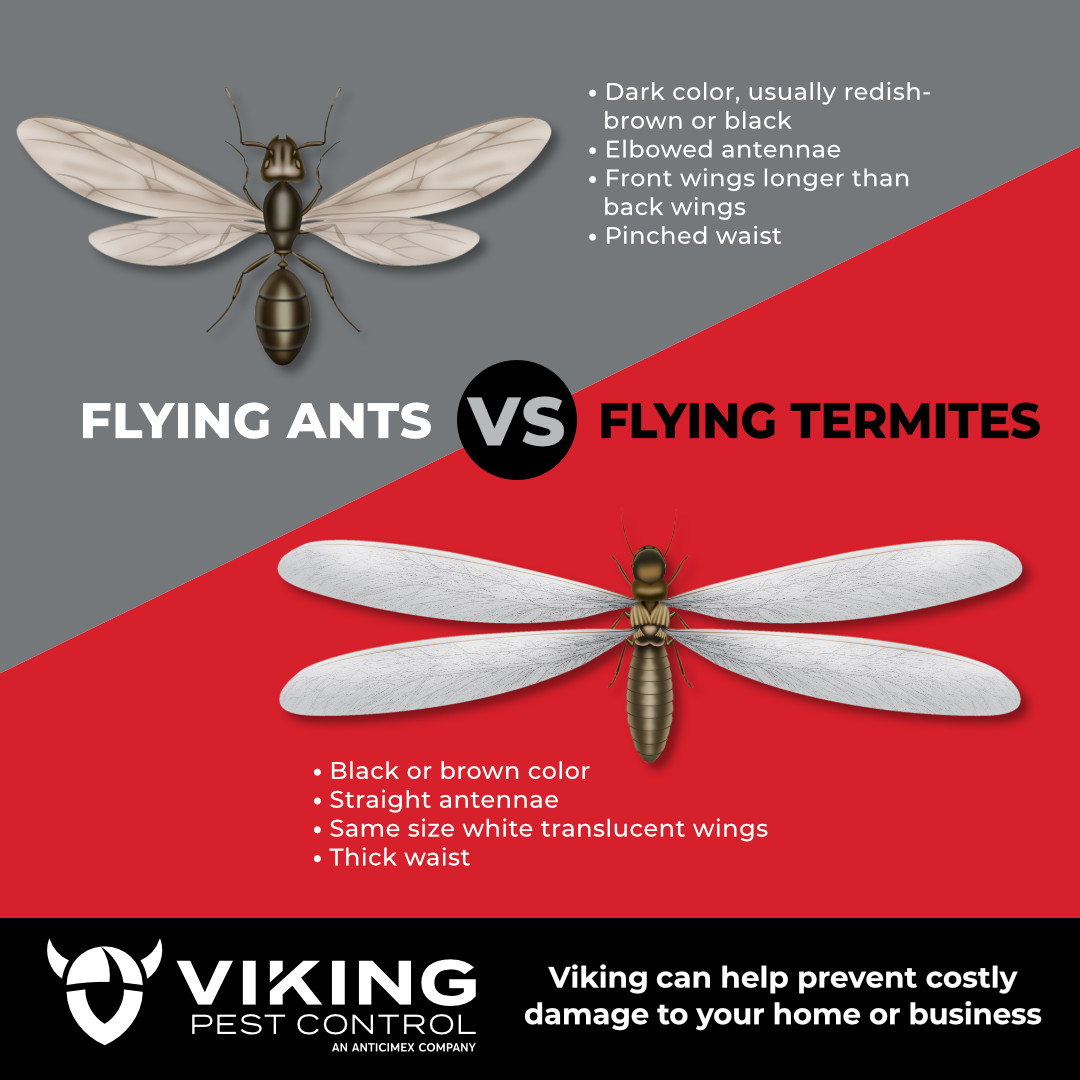
Flying ants are sometimes mistaken for termites because of their swarming behavior. The best ways to determine a flying ant from a swarming termite are their wings, antenna, and body shape:
Antennae
- Flying ants have bent antennae
- Flying termites have straight antennae
Wings
- Flying ants have larger front wings and smaller back wings
- Flying termites have equal wing lengths
Body Shape
- Flying ants have a pinched waist
- Flying termites have a narrow body that is all one width
The easiest way to determine the type of flying insect you are seeing is to call the pest control professionals at Viking Pest. Our certified pest management experts will examine the flying insect and provide their findings, along with a proactive pest management plan to eliminate the pest and prevent costly damage to your home or business.
Are Flying Ants Dangerous?
Flying ants carry the same characteristics as their crawling counterparts. A common sugar ant does not bite or sting, so a flying sugar ant will not bite or sting. Some species of flying ants, such as carpenter ants, can bite if threatened. If you do not disrupt a swarm of flying ants while they are mating, you do not have to worry about being bitten.
How Do I Prevent Ants in My Home or Business?
Ant prevention requires a multifaceted approach to have the best results. Exterminators advise not leaving excess food, trash, spilled liquids, pooled water, or crumbs around your home or business property. While these are not necessary to attract an ant infestation, there’s no need to make your property more appealing.
Beyond this, professional ant pest control is the ideal approach. It’s important to properly identify the type of ants you’re dealing with and understand the right approach to get rid of that particular species. The approach to dealing with pavement ants outside is different than the approach to exterminate carpenter ants living inside your home or business in New Jersey, Pennsylvania, Maryland, and Delaware. The ant pest control experts at Viking Pest are integral to proper identification and will help you formulate an effective, minimally invasive ant control treatment plan.
How to Get Rid of Ants
Ants are never a welcome sight in kitchens, but it’s also one of their favorite places to invade since there’s normally an abundance of food and water present. To keep ants out of your kitchen:
- Clean regularly, including around and under appliances, to remove food scraps.
- Store all your food, especially sugar and sweets, in airtight containers.
- Ensure any leaking taps are fixed to prevent attracting them with moisture.
- Seal any potential entry points, like cracks in caulking or ripped window and door screens.
- Contact a professional company like Viking Pest Control to evaluate your property, identify the source of the infestation, and eliminate it safely and effectively.
Learn More
- Where Did These Flying Ants Come From?
- What Are Sugar Ants and How Can You Keep Them Away?
- Ant Control Maintenance: Keeping Your Home Ant-Free for the Long-Term
- 4 Ways to Get Rid of Ants in the Kitchen
- Why Home Treatment Won’t Get Rid of Small Ants
Frequently Asked Questions about Ants
Protecting Your Home or Business From Ants With Viking Pest Control
Viking Pest offers expert treatment designed to effectively and efficiently control and prevent pests from invading your home or business in New Jersey, Pennsylvania, Maryland, and Delaware. Our use of Integrated Pest Management (IPM) techniques focuses on finding the core of the pest concern and controlling Ants from the source. Through IPM, pest control materials are selected and applied in a manner that minimizes risks to human health, pets, and the environment. Call Viking today for your FREE and NO OBLIGATION estimate at 1-800-618-2847 or Schedule Online today!
Schedule Service Today & Get Unlimited Service Requests*
* Some restrictions apply
Buy Online
Customer Login