

What options do home and business owners have for safely and permanently eliminating large populations of cicada killers and ground bees that live rent-free in their yards?
Although cicada killers, mining bees, ground bees, and other stinging insects pollinate plants and aerate the soil, nobody wants a large population of them right outside their back door. People who are allergic to bee or wasp stings could suffer anaphylactic reactions (facial swelling, difficulty breathing, rapid heartbeat).
Also, it's no fun to hold backyard get-togethers or sit on your front porch in the evening when the chance of a bee or wasp attack is all too real. If you're a business owner, customers won't enjoy being chased by buzzing, irate bees while attempting to enter your building.
If you try any of the following bee-eliminating methods, be aware they do involve getting perilously close to bees. For the most part, bees will leave humans alone but when they sense someone invading their personal space--look out! Your risk of suffering a sting or two--or three-- increases dramatically.
Why not play it safe and let Viking Pest handle your bee infestation issues? We use the most effective treatments available to rid your property of stinging cicada killers and ground bees so you don't have to take a chance on riling up (literally!) a hornet's nest.
How to Get Rid of Cicada Killers
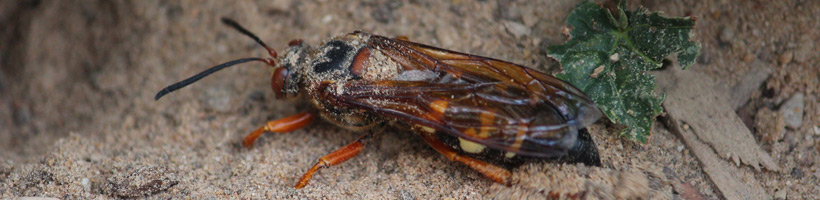
A large species of wasp with black, yellow-banded bodies and orange wings, cicada killers can capture cicadas in mid-air and paralyze them with venomous stings. However, cicada killers rarely sting humans unless they are aggressively provoked. But, if you are stung by a cicada killer, the pain and swelling it causes will likely require a doctor's attention.
As diggers and tunnelers, cicada killers can destroy plant root systems and make landscape ground unstable. Getting rid of a cicada killer infestation involves targeting the holes they make in the ground:
- After dark, pour boiling water into holes and place containers over the holes. Wasps will either drown or suffocate while trapped under containers. However, boiling water won't kill eggs.
- Pour boric acid into holes. While boric acid kills eggs and adult wasps, it won't prevent another group from returning next year.
How to Get Rid of Mining Bees
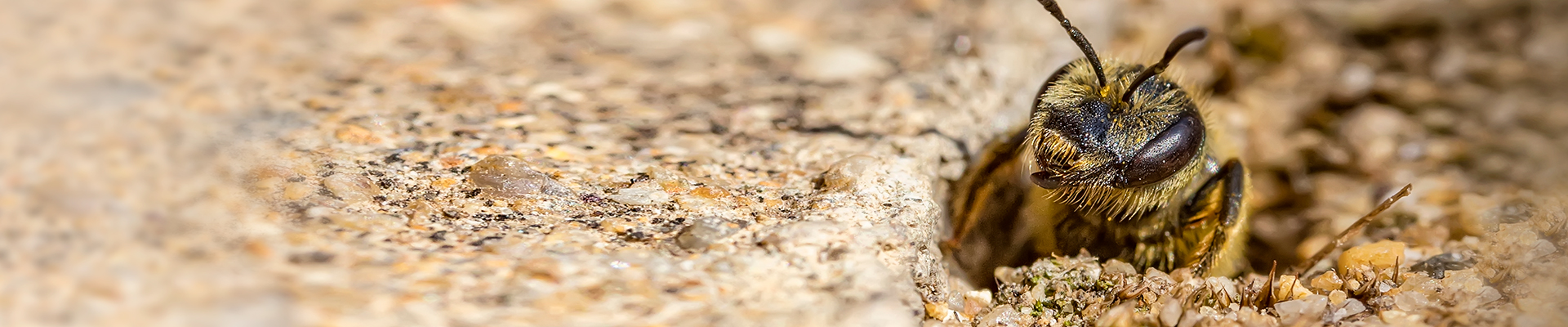
Female mining bees excavate burrows underground in which to lay their eggs. They leave behind mounds of dirt nicknamed "soil volcanoes" that may look like molehills with a hole at the top of the "hill". Although brushing down these soil volcanoes won't get rid of mining bees, they will leave your lawn or garden free of soil volcano eyesores, but only temporarily.
You can try to rid your yard of mining bees by:
- Growing geraniums, marigolds, lavender, and other bee-repelling plants around your yard
- Letting your lawn remain thicker than normal during spring and summer. Mining bees tend to gravitate towards sparser areas of grass where it is easier to dig into the ground.
- Trapping them by placing a stone or brick over the entrance to their burrow.
Although the sting of a mining bee is less painful than the sting of a cicada killer, people who are sensitive or allergic to bee stings could experience serious medical issues if stung by a mining bee.
How to Get Rid of Other Ground Bees
Most bees don't build mud or paper nests under a building's eave or in trees. In fact, 70% of all bee species build nests underground. One of the most common ground bees in the midwestern and northeastern areas of the U.S. is called Colletes inaequalis.
It's a solitary bee but females are famous for their sociable nesting behavior. Hundreds or even thousands of female C. inaequalis bees will build their nests right next to each other, as long as there is enough suitable ground that accommodates their gregariousness.
Methods for discouraging a ground bee takeover of your property include:
- Making the ground less attractive to females by irrigating heavily and placing mulch or another ground cover where grass is sparsest.
- Mix equal parts vinegar and water and spray where ground bees are nesting. Always wear protection when spraying ground bees with vinegar and water. This spray doesn't provide a contact-kill and will initially agitate them.
- Bug zappers won't exterminate the entirety of a ground bee city but may help minimize a large ground bee population.
If Nothing Works to Rid Your Home or Business of Soil Volcanoes and Stinging Bees...
Contact Viking Pest for professional solutions to your most difficult bee problems. Like other insects, a bee's determination to procreate and make thousands of other little bees is often more powerful than bespoke bee repellant. That's why we've developed evidence-based treatments to resolve your most bewildering bee brain-teasers.
Call Viking Today at 800-618-2847 today for professional pest control services or visit us at vikingpest.com.